













A good designer bag never entirely lies. The logo may look flashy from a distance, but it's the leather, stitching, and the small condition description at the checkout that reveal whether you're getting a bag that will last, or just one that looks that way in the picture. The problem is that price, hype, and logo rarely reveal quality alone, and certainly not when you look at pre-loved models.

At Stilkompagniet, we believe that good designer bags should be felt, not just seen. That's why we look for the same five signs every time a pre-loved luxury bag enters our assortment: material, craftsmanship, hardware, shape, and an honest description of its condition.
What characterizes good designer bags in practice?

Good designer bags show their quality in their construction before they reveal the logo. The difference lies in the leather, stitching, edges, hardware, and, if the bag is pre-loved, an honest description of its condition. If these five things work together, you get a bag that not only looks chic but also lasts in use.
The first thing you usually notice is the material. Good leather has depth, suppleness, and a surface that doesn't feel plastic or dead. Next is the craftsmanship. The stitches should be even, the edges sharp, and the shape balanced, even when the bag is empty.
Then come the details. Hardware should be firmly attached, close cleanly, and feel like a natural part of the construction, not just an embellishment. With pre-loved items, there's an extra layer to look for: the condition description. A beautiful bag is not automatically a good buy if signs of wear are vaguely described or not mentioned at all.
Many believe that luxury can be seen from a distance. Sometimes it can, but true quality is almost always seen up close.
Material or craftsmanship: which weighs more?
Both count, but it's the craftsmanship that determines whether beautiful leather actually holds its shape year after year. Even the softest, most exclusive leather loses value if seams, edges, and lining are weak. Material and construction must work together, otherwise you're paying for finish, not for longevity.
A soft, exclusive leather can be fantastic, but only if the bag's construction matches the material. A soft hobo bag should fall loosely and casually, while a structured top-handle bag should stand sharply and retain its shape. Here, craftsmanship controls the silhouette. If the bag collapses without being designed to do so, that's a red flag.
Some of the major design houses are known for precisely this combination: selected materials paired with production where every detail has been carefully considered. The point is the same, regardless of the brand. Luxury arises from the meeting between raw material and technique, not from one thing alone.
When evaluating a bag, you can break it down like this:
- Material: grain, suppleness, color depth, feel against the skin
- Craftsmanship: stitches, seams, edge painting, structure, and balance
If the material is beautiful but the finish is lacking, the bag will depreciate faster. If the craftsmanship is sharp but the material seems thin or artificial, you'll rarely get the true luxury feel anyway.
The 5 clearest signs of good designer bags
The surest signs are seen in the details, not in the dust bag. Craftsmanship, materials, and an honest assessment are key, whether the bag is new or pre-loved. If the hardware and condition description are also in place, you're close to a seriously strong purchase.
Here are the five signs we look for ourselves:
- An honest condition description, where scratches, patina, and light wear are clearly stated, not hidden in vague language.
- Uniform stitching without frayed threads, crooked lines, or inconsistent stitch length.
- Leather with depth and suppleness, not a stiff, plastic surface that looks good from a distance but falls flat up close.
- Hardware that feels solid, is securely attached, and shows no early fading, peeling, or rust.
- A shape, weight, and opening that make sense in use, so design and function are coherent.
The clever thing about these five points is that they apply to both new and used bags. For new bags, they reveal the build quality. For pre-loved bags, they reveal how well the bag has aged.
How to check leather quality step-by-step
Leather quality can be assessed quickly if you test it correctly. Look for grain, suppleness, color depth, and how the surface reacts to light pressure.
1. Look at the surface in daylight. Good leather often has a natural play in the grain. It doesn't have to be perfectly uniform; in fact, too much uniformity can be a sign of a heavy coating that hides the material's character.
2. Press lightly on the bag. If the leather yields and returns nicely, it's a good sign. If it crinkles, feels papery, or immediately forms hard creases, you should be more critical. Soft leather is not the same as weak leather. Nappa can be very supple and still exclusive.
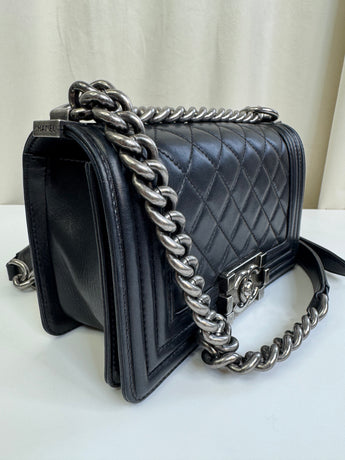
3. Look at edges and corners. This is where quality is truly tested. If the surface already appears thin, dry, or uneven in exposed areas, the bag often performs worse in daily use. If you're shopping online, zoom in specifically on corners, flaps, and strap attachments. These are the best close-ups for assessing leather quality.
How to evaluate stitching and edges step-by-step
Stitching and edges reveal more than the logo does. Some major houses are known for classic saddle stitching on central panels, a method that is strong and repairable. If stitches skip, thread frays, or edge paint ripples, the finish is rarely at a luxury level.
1. Follow the seam with your eye all the way around. Stitches should be rhythmic and even. Small deviations can occur in handmade items, but the line should still look controlled. If the seam wobbles at corners or at the opening, it's rarely a good sign.
2. Look at the stress points at handles, strap attachments, and flap closures. This is where poor construction is revealed first. Many only look at the front, which is a classic mistake. Mentally turn the bag over and assess the back, bottom, and inner seams.
3. Check the edge paint. It should be smooth and clean without drips, clumps, or early cracks. If the edge already appears brittle, it could mean faster deterioration with normal use. You don't need to find perfect saddle stitching on all bags, but you should find the same precision in execution, regardless of the brand.
What does hardware reveal that stitching doesn't?
Hardware shows durability, while stitching shows construction. The bright, gold-colored details on a bag are part of the whole, but metal alone doesn't make a bag good. If the hardware fades or loosens while seams are also pulling, the quality quickly declines.
Hardware is the bag's jewelry, but also its mechanics. A zipper should glide smoothly. A clasp should click securely. A chain should feel substantial, not hollow and rattling. Hardware should neither fade, peel, nor rust, and this is a simple, strong test to stick to, whether the bag is new or pre-loved.
Stitching tells a different story. It shows whether the bag is built to carry weight and retain its shape. A bag can have beautiful hardware and still be weak in its body. Conversely, a more understated model can be wonderfully constructed without dramatic metal.
Use this quick read when comparing:
- Hardware: weight, coating, attachment, zipper function
- Stitching: direction, tension, wear at corners, strength at straps
Many believe that heavy hardware automatically means high quality. It doesn't necessarily. Too heavy metal on a soft bag can actually distort its shape over time.
How to inspect a pre-loved designer bag before purchase
Pre-loved items require an extra quality check, and here, honest documentation is golden. At Stilkompagniet, we disclose signs of wear such as scratches, patina, and light wear before the bag is put up for sale. If pictures, text, and details match, the risk is lower and the purchase more secure.
Read the description as a document, not as sales copy. Look for words about corner wear, interior condition, hardware, odor, and straps. If the text is vague, the pictures should be extra strong. If both are lacking, it's difficult to properly assess the purchase.
Then match the description with the pictures. If you see scratches not mentioned, or color differences not explained, there's a lack of transparency. A good sign is when signs of wear are shown up close and not hidden in flattering angles.
Finally, check the functionality. Do the closure, zipper, and strap adjustment still work well? A bag can look great in pictures and still be annoying in practice. If a chain slips, a magnet doesn't close, or a strap is stretched out, it affects the real value. Always look for pictures of the bottom, corners, and strap attachments first. Those places lie the least.
How much does the condition description matter for a pre-loved designer bag?
The condition description is almost as important as the bag itself. We use details about signs of wear to set expectations correctly, because a beautiful bag without a precise description can be a weaker purchase than a less flashy model with full transparency.
With pre-loved items, quality isn't just about how the bag was made. It's also about how it has lived. Two bags of the same model can be vastly different purchases if one has dry corners, loose hardware, and discolored lining, while the other only bears light patina.
A strong condition description should cover the most important areas: corners, handles and strap, hardware, interior lining, as well as odor and storage. If the description is precise, you can better assess price against condition, and this is especially important for luxury bags, where small details can significantly shift the value.
When is patina chic, and when is wear a problem?
Patina can be beautiful on leather from major houses like Louis Vuitton or Hermès, but structural wear is something else entirely. Color warmth and softness can add character. Cracks, loose glue, distorted shape, and slack attachments, however, are signs that the lifespan is under pressure.
Patina is often superficial and aesthetic. It shows that the leather has developed naturally, especially on smooth or vegetable-tanned materials, where the color deepens over time. It can be truly lovely to look at.
Wear becomes a problem when it affects function or construction. If the edge cracks, the leather splits at stress points, or hardware comes loose, it's no longer charm. Then we're talking about reduced durability. Not all patina automatically adds more value. If the patina is uneven, patchy, or combined with dryness, you should see it as a trade-off: you get character, but you often lose several years of the bag's best life.
Should a good designer bag also function in everyday life?
Yes, function is part of quality. A bag can be handmade from the finest materials and still be impractical. If the opening, weight, or strap length don't suit your everyday life, you'll get less value from it, no matter how beautiful it is.
It sounds simple, but many overlook it. A bag can be trendy, beautiful, and perfect in the product picture, but if you never use it, the quality is only half utilized. Usability is also a form of luxury.
Think in scenarios. If you commute, the opening and organization should be quick. If you attend events, the silhouette and lightness might matter more than space. If you want one bag for most things, an adjustable strap, good balance, and moderate weight are strong plusses. Test the bag against your own must-haves: phone, cards, sunglasses, keys, lip balm. If the bag looks big but actually holds little in an impractical way, you'll quickly lose the wow factor.
Is a serial number, dustbag, and receipt enough to assess quality?
No, documents help, but they don't replace physical quality. Materials, stitching, and hardware are the key signals, no matter how many papers come with it. Paper without craftsmanship is just paper.
Documentation can enhance security, especially with pre-loved luxury, but it doesn't tell you if the leather is dried out, if the seams are pulling, or if the hardware is properly attached. A bag can be genuine and still be a weak purchase in its current condition.
If the documents are in place, use them as a supplement, not as a substitute for the quality check. If documents are missing, but the condition and details are transparent, the bag can still be interesting. If documents are present, but the craftsmanship looks wrong, alarm bells should ring.
The short version is simple: quality should be seen, felt, and described, not just proven with accessories. With an assortment of pre-loved luxury, clothing, shoes, and jewelry gathered in one place at Stilkompagniet, this is exactly the standard we adhere to ourselves every time a new, indispensable classic of a bag arrives in the store.
Frequently asked questions
What are the most important signs of a good designer bag?
The five clearest signs are an honest condition description, uniform stitching without frayed threads, leather with depth and suppleness, hardware that is solidly attached, and a shape and weight that make sense in use. These same five points reveal the build quality of new bags and how well a pre-loved bag has aged.
How do I check the leather quality on a designer bag?
First, look at the surface in daylight for a natural play in the grain, then gently press the bag to feel if the leather yields and returns nicely, and finally, look at the edges and corners. If you're shopping online, zoom in specifically on the corners, flap, and strap attachments; these are the best close-ups for assessing leather quality.
How do I assess whether stitching and edges are well-made?
Follow the seam with your eye all the way around to see if the stitches are rhythmic and even, check the stress points at handles, strap attachments, and flap closures, and finally look at the edge paint, which should be smooth without drips or early cracks. If the seam wobbles at corners or the opening, or if the edge is already brittle, the finish is rarely at a luxury level.
When is patina a good sign, and when is it wear?
Patina is often superficial and aesthetic; it shows that the leather has developed naturally and can add character and color depth. Wear becomes a problem when it affects function or construction, for example, if the edge cracks, the leather splits at stress points, or hardware comes loose.


